Guide
Is My Skincare Routine Working? How to Tell, Short and Long Term
Is my skincare routine working? The honest answer comes in two parts. Some signals show up fast: skin that feels comfortable, no stinging, a softer feel after moisturizer. But the American Academy of Dermatology (AAD) says most products take at least six weeks to work, and sometimes up to three months. The results most people care about, like fewer sun spots and slower-forming lines, take years. So the mirror is a poor judge in any single week. A better test is whether your skin feels good now, and whether the long-term habits are in place.
The ten-year feedback loop
Most habits give quick feedback. Skincare mostly doesn’t. A sunburn fades in days, but the damage behind it adds up quietly and shows years later as spots, rough texture and lines. Your skin keeps the receipts; it just hands them over late.
The clearest evidence comes from a randomized trial in Nambour, Australia, published in Annals of Internal Medicine in 2013. It followed 903 adults under 55 for four and a half years. The group asked to use sunscreen every day showed no detectable increase in skin aging, measured by changes in skin-surface texture. Their skin aged 24% less than the group who used sunscreen only when they chose to.
Nobody could have seen that difference in a week. It showed up over years, which is why “does my skin look better this month?” is the wrong question for your most important habits. For which habits matter most, see our explainer on what causes skin aging.
Signs your skincare routine is working in the first weeks
Short-term signals are about comfort, not transformation.
Comfort
After cleansing, skin should feel clean but not tight, squeaky or hot. If it feels stripped, your cleanser or washing habit may be too harsh; the AAD notes that scrubbing irritates skin.
Irritation
The AAD says stinging, burning or tingling mean a product is irritating your skin, and to stop using it. Before committing to something new, the AAD suggests testing it on a small spot, like the underside of your arm, twice a day for seven to 10 days.
Hydration
The fastest win. The AAD says a moisturizer can plump up fine lines within a few days. If skin feels softer by the end of the first week, that step is doing its job.
| Signal | When you can judge it | What it tells you |
|---|---|---|
| Stinging, burning or tingling | Minutes to days | Irritation. Stop that product. |
| Clean but not tight after washing | Days | Your cleansing is gentle enough |
| Softer, plumper feel | A few days | Your moisturizer is doing its job |
| Changes from most new products | 6 weeks to 3 months | Whether that product is worth keeping |
| Fewer new spots, slower-forming lines | Years | Whether your sun habits are paying off |
Long-term payoffs: what only years can show
Sun spots, uneven pigmentation, fine lines and rougher texture are the slow results. They reflect years of habits, especially how much unprotected sun your skin gets. The AAD puts it plainly: every time you get a tan, you prematurely age your skin, and smoking greatly speeds up how quickly skin ages.
So grade yourself differently. You can’t check this month whether your sunscreen habit is working, but you can check whether you have one. For long-term payoffs, audit the inputs, not the output.
It also means a good routine isn’t a race against time. Everyone’s skin changes as they get older, and that’s natural. The aim is graceful aging, with fewer avoidable extras piled on top.
A skincare routine checklist: audit four areas
These four areas cover most of what you can influence, roughly in order of evidence strength.
1. Sun protection
Do you wear a broad-spectrum, water-resistant SPF 30 or higher every day, not just at the beach? The AAD recommends it because UV reaches your skin every time you go outside, even on cloudy days and in winter. Do you reapply when you’re outdoors, and skip tanning, outside and in tanning beds?
2. Routine basics
Do you cleanse gently, about twice a day and after sweating heavily? Do you use a facial moisturizer every day? Do you take makeup off before bed? More washing isn’t extra credit.
3. Lifestyle
Smoking is the big one here, because it greatly speeds up skin aging. Alcohol matters too: the AAD notes it dehydrates skin and damages it over time. Sleep, diet, water and sugar come up a lot online, but their link to visible skin aging is less established than for UV and smoking. On diet, the AAD says eating plenty of fresh fruits and vegetables may help, which is about as firm as it gets. Rest is skincare too, just not the headline act.
4. Wellbeing
Stress and exercise shape how you feel and how consistently you look after yourself. The AAD suggests exercising most days of the week. Like sleep, treat these as supporting habits: worth keeping for their own sake, with a weaker link to visible aging than sun and smoking.
Your four-area habit audit
- Broad-spectrum SPF 30+ every morning, cloudy days included
- Reapply about every two hours outdoors, and after swimming or sweating
- No tanning, in the sun or in a tanning bed
- Gentle cleansing about twice a day, and after heavy sweating
- Moisturizer every day, and makeup off before bed
- No smoking, and alcohol kept moderate
- Enough sleep, some movement most days, and a way to wind down
What to change first, starting with daily SPF
Found several gaps? Don’t fix them all at once. Start where the evidence and payoff are biggest.
- Daily broad-spectrum SPF 30+. Every morning, on your face and any skin your clothes don’t cover. Daily sunscreen is the habit the Nambour trial tested.
- Reapplying when you’re outdoors. The AAD says every two hours, and right after swimming or sweating. A small tube in your bag makes it realistic.
- Stopping tanning. If you like the look, the AAD suggests a self-tanner instead.
- Smoking, if it applies. It’s one of the biggest avoidable factors for skin. If you want to stop, talk to a doctor or pharmacist about support.
- Gentle cleansing and a daily moisturizer. Low effort, with the quickest feedback on this list.
- One active ingredient, slowly. Once the basics are steady. Spot-test it, then give it six weeks to three months.
Is my skincare routine working? Set a checkpoint you can repeat
Because the loop is so long, make your check repeatable. Answer the same questions about your habits now, again after about six weeks, then every few months. The same questions each time means any change reflects what you did differently, not your mood or the bathroom lighting.
Keep it simple. Note which of the four areas are solid, which one you’re working on, and the one change you’ll make next. Hold that change for a season before you judge it.
How FutureSkin turns this into a checkpoint
FutureSkin, launching soon on iPhone and Android, is built around this kind of habit audit. You answer about 18 quick questions on your routine, lifestyle and sun exposure, which takes roughly two minutes, and get a free 0–100 routine score.
The score is calculated in code from weighted answers, not guessed by AI, so the same answers always give the same score. If the number moves, a habit moved. It uses the same four areas as the checklist above: sun protection (30 points), skincare routine (30), lifestyle (30) and wellbeing (10), and daily SPF alone is worth up to 18. It scores your habits, not your face: the number comes only from your answers, and the app doesn’t analyze your skin from a photo.
Alongside the score you get a free personalized plan: what stood out, what’s worth your attention, and numbered next steps ranked by impact. Each step explains why it helps and carries Effort and Cost labels, so you can pick a realistic first change. It names habits and product categories, like a broad-spectrum SPF 30+ every morning, never brands.
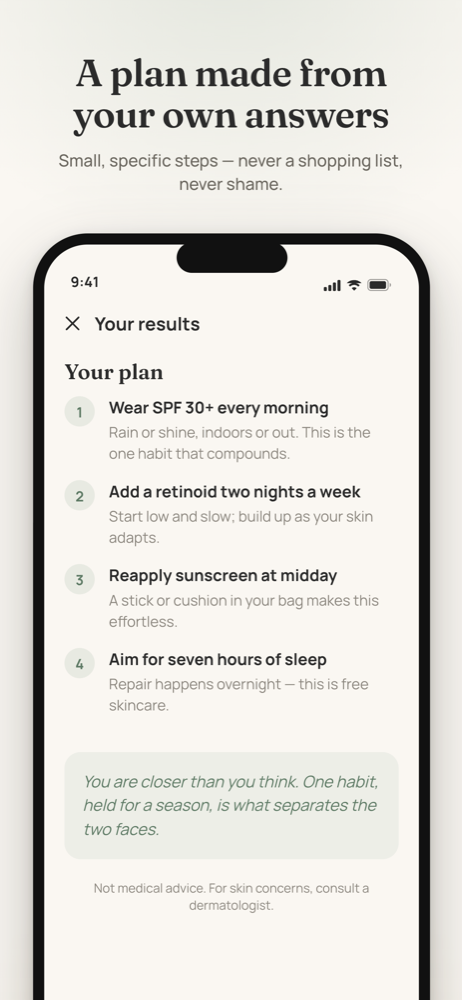
Rescan whenever you want to check in. The free tier includes up to 10 analyses a month. Your scan history lists each past scan with its date, score and band, and you can reopen any of them.
Pro puts a picture on the long-term payoff. One private selfie becomes two AI portraits of your face ten years from now: one on your current routine, one on an improved routine. They’re a motivational simulation, not a medical prediction, and portraits are for adults 18 and over. Pro is $9.99 a month or $29.99 a year, with a free trial when your store account is eligible. The score and plan stay free, and you sign in with a one-time email code. For how this differs from other apps, see face aging apps compared, or FutureSkin’s plans and pricing.
So, is your routine working? Check comfort over weeks, give products six weeks or more, and judge the long game by your habits. Start with daily SPF, change one thing at a time, and come back to the same checkpoint in a few months.
Frequently asked questions
How long does skincare take to work?
What are the signs your skincare routine is working?
Should I change my whole routine if I don't see results?
What should I change first in my skincare routine?
When should I see a dermatologist about my routine?
Keep reading
More from the FutureSkin blog

Explainer
What Causes Skin Aging? Sun, Sleep, Smoking, Stress and Sugar
Most of the aging you can influence comes from a few habits, led by UV. Ranked honestly by the evidence, without anti-aging panic.

Comparison
Face Aging Apps Compared: Filters, Skin Scanners and Simulations
Most aging apps age everyone the same way for a laugh, or score your skin to sell you something. What a routine-based simulation does differently, and what to ask before uploading a selfie.