Comparison
Face Aging Apps Compared: Filters, Skin Scanners and Simulations

A face aging app takes a selfie and shows you an older version of your face. Under that one label sit three quite different tools. Novelty filters age everyone the same way, for a laugh. Skin-scoring apps analyze how your skin looks today, and many end with product suggestions. Routine-based simulations start from your habits and show two futures: the one your current routine points to, and a kinder one. Pick the type that matches what you want, and read the photo policy before you upload anything.
Three types of face aging app
Search for an age progression app, or a "what will I look like when I'm older" app, and the results blur together. They are built for different jobs, though, and the job matters more than the filter quality.
- Novelty filters. Upload a selfie and get grey hair and deeper lines in seconds. Built for sharing. The aging look is generic.
- Skin-scoring apps. Analyze a photo of your skin as it is now and return scores or a "skin age", often followed by a routine of recommended products.
- Routine-based simulations. Ask about your habits first, age your photo according to them, and show a second version of you on a better routine.
Face aging apps compared: the criteria that matter
The table compares the three types on the questions that decide whether a result is useful and whether your photo is looked after. Individual apps differ, so read it as a map of what to check, not a verdict on any one product.
| Criterion | Novelty filter | Skin-scoring app | Routine-based simulation |
|---|---|---|---|
| Personalized to your habits? | No. The same aging style is applied to every face. | Partly. Based on how your skin looks in the photo, sometimes plus a short quiz. | Yes. The aging effects come from your answers about sun, sleep, smoking and routine. |
| Identity preserved? | Not the priority. The goal is a fun, shareable look. | Not the goal. You get scores, not a future portrait. | The aim. Look for one that keeps your face, pose and lighting and avoids caricature. |
| Shows a better alternative? | No. One aged version. | Indirectly, through product suggestions. | Yes. A current-routine future next to an improved-routine future. |
| What you leave with | A picture to share. | A snapshot of today, often with a product list. | A habit plan and a reason to follow it. |
| Privacy question to ask | Is the photo edited in the cloud, and how long is it kept? | Is the photo tied to a shopping or marketing profile? | Is location data stripped, is storage private, and can you delete it? |
| Price | Varies. Check for in-app purchases and auto-renewing plans. | Varies. Brand-run advisors, such as Olay's, sit inside the brand's own shop. | Varies. FutureSkin: free score and plan, portraits with Pro. |
| Age limits | Check the store rating and terms. | Check the terms. | Check the terms. FutureSkin portraits are 18+ only. |
Novelty filters: quick laughs, the same aging for everyone
Novelty aging filters are the kind that go viral: take a selfie, tap a filter, and you have silver hair and deeper lines a few seconds later. They are fun with friends, and there is nothing wrong with that.
What they can't do is tell you anything about your own future. The filter doesn't know whether you wear sunscreen, smoke or sleep five hours a night, so a heavy smoker and a daily-SPF devotee get the same aged face. There is also only one future on offer, so there is nothing to compare it with and no obvious next step.
The question worth asking here is what happens to the photo. FaceApp, whose old-age filter went viral in 2019, is an example of a clear answer: its privacy policy says photos are edited on cloud servers and may stay cached there for 24 to 48 hours after your last edit, and that the app is not directed at children under 13. Whatever filter you try, look for that level of detail.
Skin-scoring apps: a snapshot of your skin today
Skin-scoring apps look at your face as it is now. They may rate things like lines, spots or texture, or give a single "skin age". Many are run by skincare brands, so the result leads into a routine of their own products. Olay's Skin Advisor, for example, says it analyzes your skin to deliver personalized routines, and it sits on Olay's own shop.
A snapshot can be interesting, but it shows today, not where your habits are heading. A photo-based score also depends on the photo, so ask how light, camera and makeup affect it, and whether the tool is independent of the products it suggests.
Most of all, a score from a selfie is not a diagnosis. Not medical advice — for any skin concern, consult a dermatologist.
Routine-based simulations: FutureSkin, launching soon
A routine-based simulation flips the order. It starts with what you do, not with your face, and it shows two futures instead of one. There is some research behind the idea of seeing your future self. In a 2020 cluster-randomized trial in Brazilian secondary schools, published in JAMA Dermatology, classes saw their own selfies aged by UV exposure. Six months later, reported daily sunscreen use in those classes had risen from 15.0% to 22.9%, while the control classes showed no significant change. That was one app, one age group and a classroom setting, so it is promising rather than proof.
How FutureSkin works
FutureSkin is our app, and it is the routine-based option. It is launching soon on iPhone and Android.
- Answer about 18 quick questions, about two minutes, on you, your routine, your lifestyle and your environment: SPF 30+ and reapplying, cleansing, moisturizer, makeup removal, sleep, smoking, alcohol, stress and sun exposure.
- Get a free 0–100 routine score. It is calculated from weighted answers, not guessed by AI, so the same answers always give the same score. Daily SPF carries the most weight of any answer.
- Read your free plan: what stood out, what is worth your attention, and next steps ranked by impact, each with its effort and cost. It names product categories and habits, never brands.
- With Pro, take one selfie. FutureSkin turns it into two AI portraits of your face ten years from now, one on your current routine and one on an improved routine, and you compare them in a Now / In 10 years slider.
The current-routine portrait uses aging effects linked to the habits your answers flagged, such as low sun protection or smoking, and renders them subtly if your routine already scores well. The improved-routine portrait shows graceful aging. The image instructions ask to keep your identity, pose, background and lighting, with no caricature. Each result is labeled "AI-generated simulation — illustrative only": a motivational simulation, not a medical prediction, and two runs can differ.
One thing it does not do is scan your skin. The score comes only from your answers, and the selfie is used only to create the portraits.
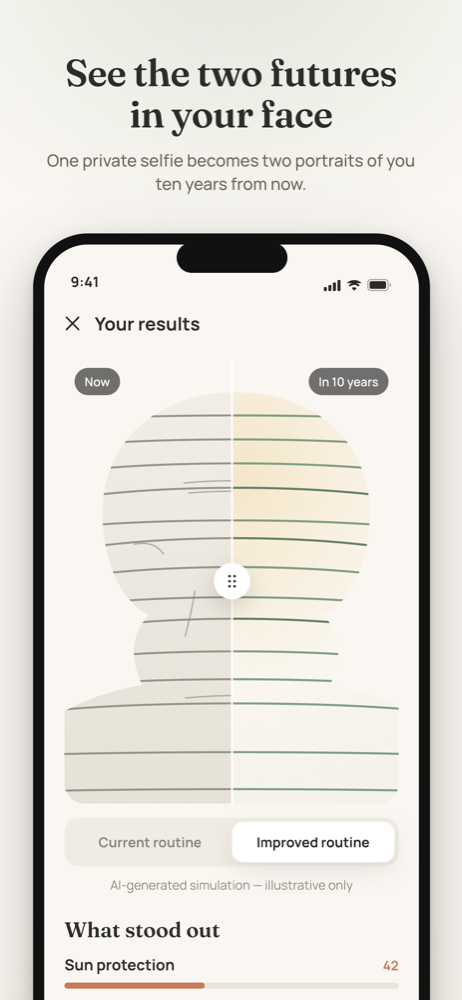
Photo handling, price and age limits
- Before your first scan, a consent screen explains that your answers and photo go to Anthropic (Claude), with OpenAI as a backup and for the portraits, and asks you to confirm the photo is of you.
- The photo is resized and stripped of EXIF and location data on your phone. It is stored privately in your account, never used to train models, and deletable anytime. Delete account in Settings erases your selfies, portraits and answers.
- Portraits are 18+ only. Anyone who answers "Under 18" gets the score and plan only.
- The score and plan are free, up to 10 analyses a month, with an email one-time code to sign in and a non-personalized banner ad. Pro is $9.99 a month or $29.99 a year, with a free trial when your store account is eligible, and covers 30 portrait scans and 100 analyses a month. See pricing.
Questions to ask before uploading a selfie to a face aging app
Your face is sensitive data. The US Federal Trade Commission's 2023 policy statement on biometric information says a photograph of a person's face counts as biometric information. Whatever app you try, look for plain answers to these:
Before you upload
- Where is the photo processed, on your phone or on a server, and by which company?
- How long is it kept, and can you delete it yourself, inside the app?
- Is it ever used to train AI models or shared with partners?
- Is location data removed? Photos can carry location metadata that the people you share them with may be able to see. Apple explains how to check and remove it.
- Does the app ask you to confirm the photo is of you, and does it have an age limit?
- If there is a free trial, when does it renew, and how do you cancel?
- Does it make medical claims? An aging app shouldn't diagnose anything.
If a privacy policy can't answer these in plain words, that is an answer too.
Which face aging app suits you?
- You want a laugh with friends. A novelty filter is fine. Keep expectations playful and check how long the photo is kept.
- You are curious how your skin looks today. A skin-scoring app gives a snapshot. Remember that brand tools lead to their own products, and any real concern belongs with a dermatologist.
- You want a reason to change a habit. A routine-based simulation is built for this. It ties the picture to what you do and shows the kinder path next to the current one.
Aging is natural, and the useful question is which habits you can shift. Our guide to what causes skin aging ranks those habits by evidence, and is my skincare routine working? shows how to check yours without waiting ten years to find out.
Frequently asked questions
Are face aging apps accurate?
Is it safe to upload a selfie to a face aging app?
What is the best app to see yourself in 10 years?
Can a face aging app tell my skin age?
Is there an age limit for aging apps?
Keep reading
More from the FutureSkin blog
Guide
Is My Skincare Routine Working? How to Tell, Short and Long Term
Skincare has a feedback loop about ten years long. Audit the habits rather than the mirror, and keep a checkpoint you can repeat.

Explainer
What Causes Skin Aging? Sun, Sleep, Smoking, Stress and Sugar
Most of the aging you can influence comes from a few habits, led by UV. Ranked honestly by the evidence, without anti-aging panic.